

Last Updated: 23 June 2026
Disclaimer: This article reflects the ground-reality in Bali as of mid-2026. Owners should consult with a specialized legal advisor before making major structural changes.
The conversation around villa compliance in Bali has reached a tipping point. While the March 31, 2026, milestone for Online Travel Agencies (OTAs) has passed, it wasn’t a sudden regulatory shift. Instead, the government’s active task force is maintaining momentum, with a firm August 2026 deadline for platforms like Airbnb and Agoda to remove illegal listings (read). This signals that authorities are steadfast in their enforcement efforts, making the pressure to “be legal” higher than ever.
However, as a partner to hundreds of owners, we need to be honest: the “legal villa” remains a complex puzzle. While authorities are aggressively pushing for a structured enforcement environment, a significant gap remains between the strict laws on the books and the digital systems that process them.

1. The End of the “Wild West” (And Why That’s Good)
For close to two decades, Bali operated like the “Wild West” of real estate—a period of rapid, often unchecked growth. While this brought investment, it also led to over-development and unsustainable pressure on Bali’s infrastructure and environment.
The shift toward regulation is fundamentally necessary. It is the only way to protect Bali’s unique character, ensure fair tax contributions to local communities , and stop the encroachment into protected agricultural lands. The “Wild West” era was profitable for some, but it was a debt being charged to Bali’s future.
While official databases know of about 10,000 villas, OTAs show up to 40,000 listings. This massive gap has pushed some to say that the market is mostly irregular. However, we want to be careful before blaming anyone. As we’ll see below, navigating full compliance is incredibly complex. At the same time, everyone needs to step up here and clean up this mess: authorities, operators, and owners.
2. The Enforcement Reality: A High-Stakes Limboo
The Indonesian Ministry of Tourism, in collaboration with local Bali authorities and major Online Travel Agencies (OTAs), has officially launched a compliance enforcement campaign. The message is clear: the national government is moving toward full business compliance across all operating properties.
Under Government Regulation No. 28 of 2025, authorities mandate that all accommodation providers possess a valid business license. The primary focus of enforcement centers on two specific baseline documents:
- NIB (Nomor Induk Berusaha): Your unique Business Identification Number.
- KBLI (Klasifikasi Baku Lapangan Usaha Indonesia): The standard classification code that dictates your legal scope of operations.
The OTA Silence: Despite recent enforcement deadlines, major platforms like Airbnb and Booking.com remain inconsistent. They are collecting NIBs and KBLIs and displaying them on their websites, but absolute transparency regarding widespread inventory deactivation remains elusive. If they rigorously cross-reference every listing against strict spatial and corporate requirements, they risk losing a massive percentage of their inventory. At Villa Finder, we have long refused to list any villa in a “Green” (agricultural) zone —a check that the major OTAs have historically ignored.
The BVRMA’s Frustration: Even the Bali Villa Rental and Management Association (BVRMA)—the primary bridge between owners and the government—continues to navigate shifting goalposts as central and regional directives adapt in real-time.
3. The KLBI Catch-22 for Foreign Owners
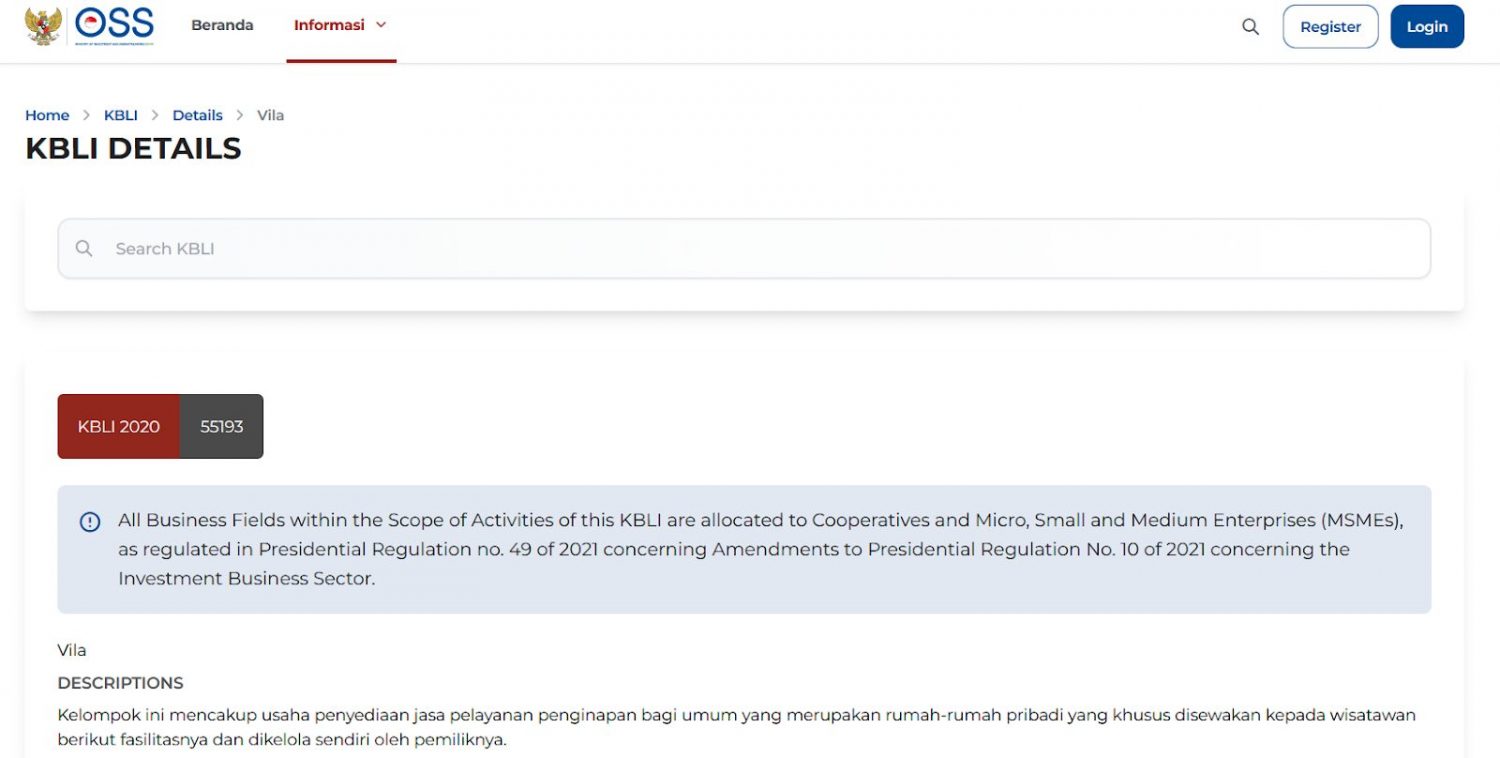
Before anything, we must establish a distinction between ownership and operations. Foreigners require a Foreign Investment Company (PT PMA) to legally hold and control land or property leases. However, setting up a company does not automatically grant the right to run short-term villa rentals. You must ensure the company holds the proper, operational classification.
This is where the ultimate Catch-22 emerges for foreign owners under Presidential Regulation No. 49 of 2021 , heavily exacerbated by Bali Regional Policies (specifically Governor Letters No. B.27.000/5753/PM/DPMPTSP and No. B.27.000/642/PM/DPMPTSP).
In practice, Bali’s local policies restrict PT PMAs from utilizing Low Risk and Medium-Low Risk KBLIs. Because standard villa structures fall under these lower-risk tiers, foreigners are strictly closed off from direct ownership of standard villas or homestays in Bali.
| KBLI Code | Business Name | Risk Level | FDI Eligibility (National & Bali Regional Policy) |
| 55110 | Starred Hotel (Hotel Bintang) | Medium-High to High | OPEN – Strictly limited to building areas exceeding $6,000\text{ m}^2$ (Excludes 1-star). CLOSED if building is $<6,000\text{ m}^2$. |
| 55120 | Non-Starred Hotel | Medium-Low | CLOSED to foreign ownership. |
| 55130 | Pondok Wisata (Homestay) | Medium-Low | CLOSED to foreign ownership. |
| 55191 | Youth Hostel | Medium-Low | CLOSED under Bali Regional Policy. |
| 55192 | Campgrounds & Caravan Parks | Medium-Low | CLOSED under Bali Regional Policy. |
| 55193 | Villa | Medium-Low | CLOSED to foreign ownership. |
| 55194 | Apartment Hotel | Medium-High | OPEN to foreign ownership. |
| 55199 | Other Short-Term Acc. | Medium-Low | CLOSED to foreign ownership. |
The Reality: As it stands, the only accommodation classifications fully open to foreign investment via a PT PMA in Bali are KBLI 55110 (Starred Hotels with a building area exceeding 6,000 m²) and KBLI 55194 (Apartment Hotels). Older PT PMAs that mistakenly hold legacy, now-restricted codes risk being flagged as non-compliant.
For foreign owners, this creates a clear obstacle: you cannot hold the required Villa license directly. The solution is to partner with a local PT PMDN company that holds the license on your behalf. Villa Finder offers a specialized PT PMDN solution designed to navigate this regulatory landscape and keep your property compliant. Contact our team at owners@villa-finder.com to learn more.
4. The New Law: KBLI 2025 (BPS Regulation No. 7/2025)
A major shift occurred with the introduction of BPS Regulation No. 7 of 2025, which rolled out specialized tourism codes intended to better classify the industry (such as KBLI 55203 for Villa Activities, 55204 for Serviced Apartments, and 55400 for Property Management).
The “Paper vs. Practice” Gap: While this law officially went into effect on December 18, 2025, the government instituted a six-month transition period. Full integration into the Ministry of Law’s AHU system and the Online Single Submission (OSS) platform is slated for completion by June 18, 2026.
Until digital systems fully catch up, many owners have been stuck in a “Legacy Mapping” trap—forced to rely temporarily on older KBLI 2020 codes. As this transition window closes, “approximate” licenses face immediate pressure to align perfectly with the finalized system. Every single company will need to actively update its KBLI codes; there is no grandfathering of old codes. Owners should prepare for this update immediately to maintain compliance.
5. The “Authority Gap”: Coaching into Obsolescence
The most frustrating part for owners is that the authorities themselves often appear disconnected from their own upcoming timelines. During various “coaching clinics” held across the island, many local officials continued to train operators on the outgoing administrative steps without addressing how the finalized system integration will disrupt current filings. Owners are essentially being coached on a mechanism that is actively transforming beneath them.

6. The Tip of the Iceberg: NIB is Not “Legality”
Many owners believe an NIB is the finish line. In reality, it is just the entry ticket. Under risk-based licensing, properties classified under Medium-High frameworks (like legal foreign-operated accommodation) require an NIB plus a Verified Standard Certificate complying with Minister of Tourism Regulation No. 6 of 2025.
To be truly compliant, a property requires a complex, perfectly aligned stack of approvals:
- Zoning & KKPR (Spatial Utilization Conformity): Your land must be located inside an approved Tourism Zone. Residential or Agricultural zones are absolute deal-breakers.
- LSD Verification (Protected Rice Fields): Even within a good zone, you must verify via Bhumi (the national land information system) that the plot is entirely free from an LSD designation. Building on protected rice fields is strictly forbidden.
- Building Approval (PBG) & Occupancy Certificate (SLF): Formally known as the IMB, your PBG must be secured before construction and explicitly state commercial/tourism use. An SLF is legally mandatory before the building can host a single operating guest.
- Operational & Supporting Licenses (PB UMKU): This includes the Certificate of Proper Hygiene and Sanitation (SLS), which serves as a mandatory, standalone requirement to ensure rigorous health and safety compliance. Additionally, properties must secure an Alcohol Sales License (SKPL) if beverages are sold on-site.
- Tax & Labor Compliance: Strict alignment across national and local tax structures (NPWP and NPWPD), alongside full adherence to staff employment mandates (BPJS, minimum wage, and THR payouts).
7. Practical Pathways: What We “Know” To be True
In 2026, complete compliance requires meticulously working through the ongoing system updates. However, several foundational principles remain absolute:
- Nominee Structures are Illegal: Foreigners cannot directly own freehold land; you must utilize a legitimate PT PMA vehicle to secure land protection.
- Leasehold vs. Right-to-Build (HGB): When securing land through a PT PMA, you must strategically weigh your tenure options:
- Leasehold is faster, highly flexible, and requires lower upfront capital, but grants no structural asset ownership.
- HGB (Right-to-Build) involves a formal title transfer and Land Office registration. It is document-heavy and more costly, but provides complete rights and lasting asset value for the title’s duration.
- Currency Regulations: You cannot set prices or market your property to users inside Indonesia in USD or any foreign currency; transactions must remain in IDR.
- Onshore Revenue: All revenue must be recognized transparently in Indonesia with all local and corporate taxes paid continuously.
- Local Customary Law (Hukum Adat): Legal paperwork is only half the battle. Bali operates under a plural legal system where customary village laws (awig-awig and perarem) hold immense constitutional and practical power. Maintaining a constructive relationship and ensuring alignment with your local Desa Adat and Banjar is mandatory for smooth, long-term operations.
Your goal should always be “Maximum Defensibility”—proving that you have actively taken every verifiable step possible within the current regulatory architecture.
The Villa Finder Perspective

We believe in absolute transparency. We won’t tell you that an NIB automatically makes you “legal”. It doesn’t. But we will help you navigate the chaos. Stay tuned for updates.
Need More Assistance?
- Government Hotline: The Ministry of Tourism has established a WhatsApp Contact Center for licensing questions at 0811-895-6767.
- Professional Help: For navigating the specific complexities compliance, contact our team at owners@villa-finder.com





Comments are closed.