

For a decade, the Bali villa market operated on a “Field of Dreams” logic: If you build it (and it’s pretty), they will come.
The formula was deceptively simple:
- Aesthetic Design: Polished concrete, sunken lounges, and tropical greenery.
- Platform Presence: A high-ranking Airbnb or Booking.com listing.
- The North Star Metric: High Occupancy.
For years, a full calendar was the ultimate badge of honor. But in 2026, that badge is starting to look like a liability. While many owners are celebrating 90% occupancy, their bank accounts are telling a different story—one of rising overheads, stagnant net yields, and “busy-ness” masquerading as business.
What Changed in the Bali Villa Market in 2026
It’s a common misconception that the market is struggling due to a lack of tourists. The data says otherwise. According to the Badan Pusat Statistik (BPS), foreign arrivals reached 6.33 million in 2024—a 20% year-on-year surge that confirmed the rebound.
The problem isn’t demand; it’s the dilution of that demand.
With over 83,000 active listings now tracked across Bali (AirDNA), the supply of “pretty boxes” has finally outpaced the surge in travelers. We have reached a point of peak commoditization.
Why the Old Villa Success Formula No Longer Works
To understand why the old model is breaking, we have to look at the environment that birthed it. The “Classic Success Model” thrived in a vacuum of competition:
- Scarcity: There were simply fewer villas. Being “available” was a competitive advantage.
- Low Friction: Regulatory pressure was minimal, and operational costs (labor/utilities) were a fraction of today’s rates.
- Low Expectations: A private pool was once a luxury; in 2026, it is the bare minimum.
Back then, visual appeal was a differentiator. Today, “tropical chic” is the entry fee. When every villa on page one of a search result looks like a Pinterest board, design stops being a reason to book and starts being a commodity.
Why High Occupancy Is a Misleading Metric for Villa Performance
This is where the math of 2026 gets uncomfortable for the traditional owner. Many are still chasing Occupancy as their primary KPI, failing to realize it has become a “Vanity Metric.”
In the current landscape, high occupancy is often the smoke that signals a fire in your profitability.
Consider two villas competing in the same Canggu sub-district:
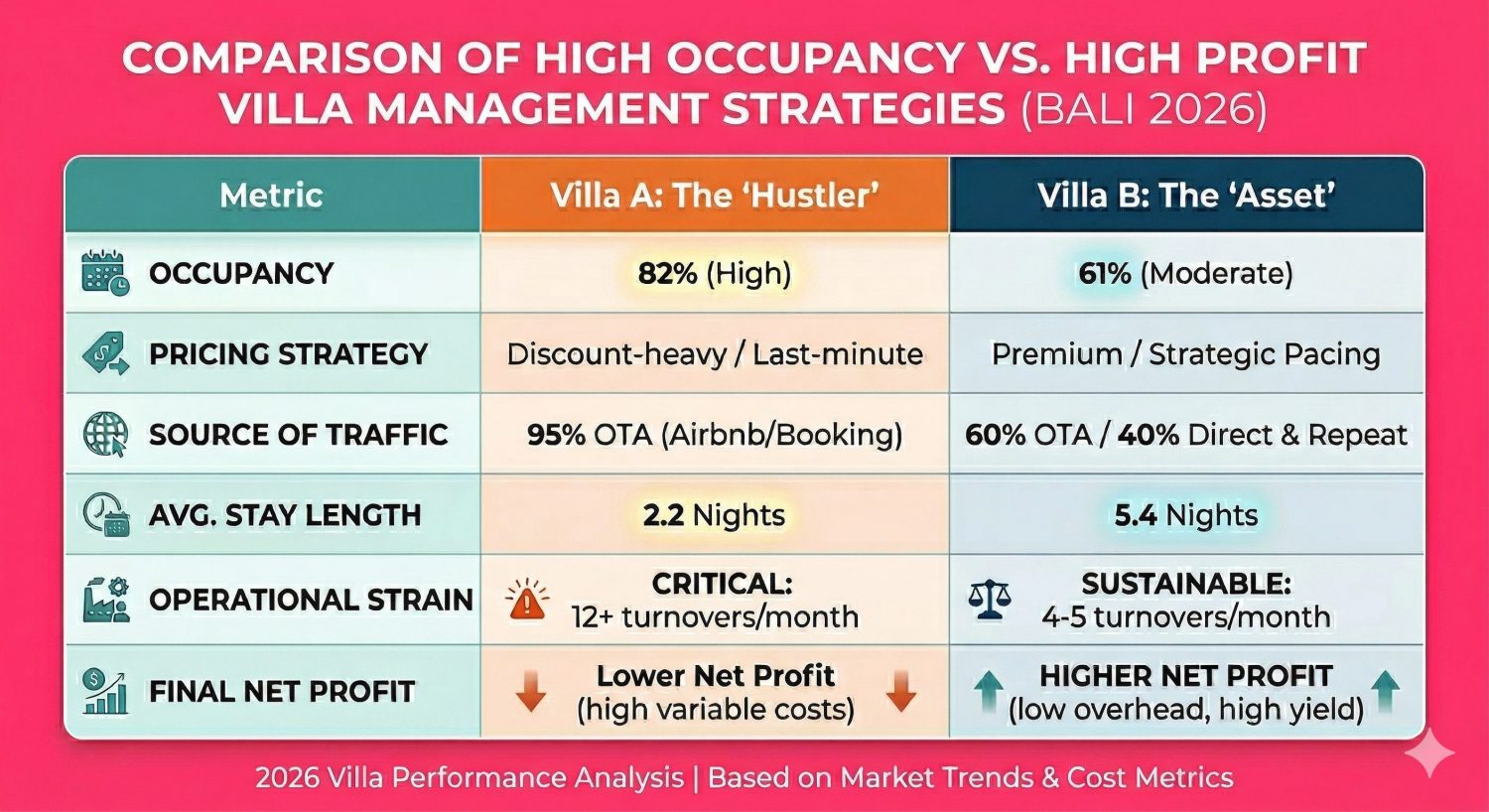
The Reality Check:
Villa A is “busier,” but it is bleeding profit. Every turnover in 2024-2026 costs significantly more than it did three years ago. Between cleaning labor, laundry wear-and-tear, “check-in friction,” and OTA commissions, Villa A is essentially subsidizing the guest’s vacation.
Villa B earns more net profit with 35% less “work.”
What a Busy Booking Calendar Really Costs
In 2026, high occupancy without high Net Yield brings a host of invisible costs:
- The Maintenance Debt: Constant foot traffic prevents deep maintenance. Small leaks become structural issues.
- Staff Burnout: High turnover rates lead to fatigue, lower service standards, and higher staff churn.
- The Review Trap: More guests = more opportunities for a 4-star review. In a commoditized market, one bad review for a “minor friction” issue can drop your ranking by pages.
Why Net Yield Matters More Than Occupancy in 2026
If occupancy was the old way of keeping score, Net Yield is the new one. In the 2026 market, revenue without margin isn’t performance—it’s just noise.
What Net Yield Actually Measures
At its core, the formula is brutal: Net Yield = Total Revenue – (Operating Expenses + Statutory Burdens).
Most owners fail because they stop calculating after the OTA commission. To find your true yield in 2026, you must account for the “Silent Deductions”:
- Variable Operational Costs: Housekeeping labor, guest consumables, and the 2026 surge in utility rates.
- The Maintenance Capex: A “Pretty” villa requires constant touch-ups to remain competitive.
- The Compliance Tax: As Indonesian regulators tighten the screws, licensing and environmental waste management are no longer optional—they are fixed overheads.
Expert Insight: Per the Ministry of Tourism’s March 31, 2026, deadline, villas failing to meet full licensing requirements face delisting from major OTAs. Compliance is now a direct driver of your bottom line.
Why Length of Stay and Revenue Stability Matter More in 2026
One of the most overlooked shifts in Bali is the move from “Nights Sold” to Length of Stay (LoS). In 2026, LoS is no longer a booking detail; it is a strategic defense mechanism against inflation.
Short stays (1–2 nights) are “friction heavy.” They require a total reset of the villa, high coordination costs, and increased wear on MEP (Mechanical, Electrical, Plumbing) systems.
By contrast, longer stays (5+ nights) offer:
- Compressed Turn-Costs: You pay for one deep clean instead of three.
- Revenue Stability: A 7-night booking provides a “pacing anchor,” allowing you to hold your price discipline for the remaining dates.
- Predictive Staffing: You can schedule labor with precision rather than reacting to a chaotic, high-turnover calendar.
Why Pacing Matters More Than Most Villa Owners Realise
Two villas can end the month with 80% occupancy, but one can be 30% more profitable than the other. The difference is Pacing.
Pacing tracks when your bookings arrive.
- Healthy Pacing: You secure your “Base Layer” 60 days out at your target ADR (Average Daily Rate).
- Panic Pacing: You have a blank calendar 10 days out and slash prices to fill it.
Late bookings create pricing pressure. When you discount to fill gaps, you aren’t just losing money on that booking; you are training the algorithm to see your property as a “discount” listing, which destroys your long-term authority.
Why Instagrammable Villas No Longer Guarantee Bookings
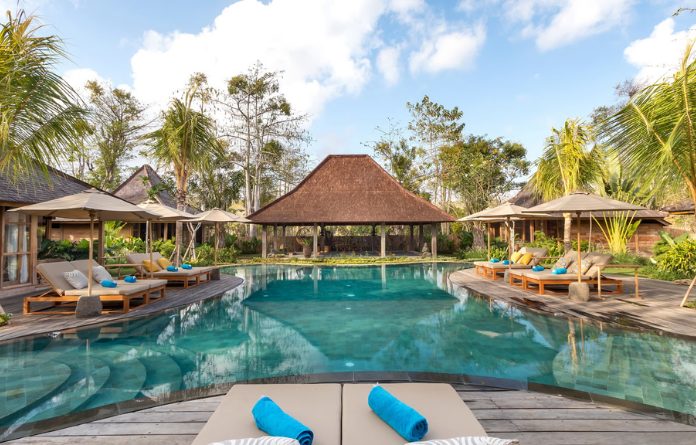
For nearly a decade, the Bali villa market operated on a “Novelty” curve. If you built a villa with a sunken lounge and an infinity pool, you were virtually guaranteed to go viral. But in 2026, the market has moved into its third and most dangerous stage: Commoditization.
How Bali Villas Became Commoditised
In a commoditized market, products become interchangeable. Walk through the listings in Canggu or Uluwatu today and the “visual story” is identical: the same neutral linens, the same boho-chic textures, and the same floating breakfasts. This isn’t a design failure—it’s a sign of a mature market where “tropical chic” has become the baseline requirement rather than a competitive advantage.
Why Similar Villas End Up Competing on Price
When every villa on page one looks like a Pinterest board, the guest’s only remaining comparison point is the nightly rate. This creates a “Race to the Bottom” where owners are forced into a Slow Drift into Discounting. They maintain the illusion of success through high occupancy, but their net yield is quietly being devoured by the cost of competing on price alone.
How Guest Decision-Making Has Shifted
The hardest pill for owners to swallow in 2026 is that guests now assume the villa will be beautiful. Beauty is no longer the deciding factor; Reliability is.
The modern guest has developed a “zero-tolerance” policy for the gap between Instagram and Reality. A 5-star design cannot save a 1-star operational experience. Success in 2026 belongs to the villas that solve for the new high-value guest segments:
- The Family Pivot: These are the power-buyers of the Asia-Pacific market. They don’t book for “vibes”; they book for pool fences, functional kitchens, and safety.
- The “Slow-mad” Professional: Remote workers staying 14+ days who prioritize redundant Wi-Fi and ergonomic workspaces over “boho” decor.
- The Frictionless Traveler: Guests who value an instant, automated check-in and proactive communication over a “pretty” but poorly managed property.
In short: In a market of identical “pretty boxes,” the only way to escape the commodity trap is to move from selling a Product (the house) to selling a Result (a frictionless, reliable stay).
Service as the New Alpha: From “The Product” to “The Stay”
In 2026, the villa is no longer the product; the stay is. Once design becomes standard, the real differentiator is everything that happens around it: how smoothly the booking feels, how clearly expectations are set, and how reliably the experience is delivered from first inquiry to check-out.
Guests today are not simply looking for luxury — they are looking for ease and confidence. That means operational reliability matters more than ever. Slow WhatsApp replies, unclear check-in instructions, inconsistent housekeeping, or poorly maintained equipment all create friction. And friction is expensive. It lowers conversion rates, weakens reviews, and pushes operators back into discounting.
Why Service Drives Revenue, Not Just Good Reviews
In today’s review-driven market, trust is one of the few remaining pricing advantages. Villas with consistently strong guest experiences tend to maintain pricing discipline, while weaker operators often rely on discounts to fill gaps. Guests compare options instantly, and they rarely complain about friction — they simply move on to the next listing.
That shift means service quality is no longer a “nice-to-have.” It is a revenue tool. Reliable communication, predictable operations, and consistent guest experiences allow properties to protect their rates even in crowded markets.

Why Understanding Your Guest Persona Is the Real Competitive Advantage
One of the biggest mistakes villa owners make is trying to appeal to everyone. In a commoditized market, that approach weakens your positioning and forces you into price competition. High-performing villas do the opposite — they become extremely clear about who they are designed for.
Understanding your guest persona allows you to build a Unique Selling Point that feels intentional, not generic. It also makes your listing easier to understand within seconds — which matters more than most owners realize. Guests scroll quickly, compare options rapidly, and make decisions emotionally before they make them logically.
The strongest listings do not just describe features — they signal identity.
- A family-oriented villa, for example, should visually confirm that children are welcome and safe. That might mean showing pool toys, board games, bunk beds, or shaded outdoor play areas directly in the photography. These details create reassurance before a guest even reads the description.
- A villa designed for groups of friends might highlight social energy instead of safety. That could include clear messaging around welcome drinks, barbecue areas, long dining tables, or lounge spaces built for shared experiences. Something as simple as including a welcome case of Bintang or showing relaxed group moments in photos can shift perception from “just another villa” to “this feels like our kind of place.”
- Other villas win through smaller emotional hooks — details that create memorability rather than scale. A vinyl player with curated records, a cold plunge for wellness-minded travelers, a home cinema for rainy evenings, or a cozy firepit setup can become signature elements that guests remember long after checkout.
The goal is not to add more features. The goal is to create clarity. Because once a villa becomes clearly designed for someone, it stops competing on visuals alone. It starts competing on relevance — and relevance is far harder to discount.
What a Successful Villa Looks Like in 2026
Let’s reset the definition of success. A winning villa is no longer the one with the most “likes” on Instagram; it is the one that is Financially Stable, Operationally Controlled, and Predictably Profitable.
Winning operators focus on four measurable traits:
1. Balanced Occupancy (The “Anti-Hustle”)
Success is not 100% occupancy. It is achieving a moderate, high-yield occupancy (60–70%) that protects your property from excessive wear and tear while maximizing the nightly rate.
2. Strategic Pacing
Healthy assets have a “Base Layer” of bookings months in advance. If you are filling your calendar 48 hours before check-in, you aren’t an investor; you’re a gambler.
3. Optimized Length of Stay (LoS)
As we analyzed earlier, longer stays correlate directly with profit. Winning villas in 2026 have moved away from the “Weekend Warrior” market in favor of families and “Slow-mads” who provide more revenue with 80% less operational friction.
4. The Maintenance “Moat”
In Bali’s harsh tropical environment, maintenance is a strategic investment. Proactive upkeep prevents the “Negative Review Spiral” and protects the asset’s long-term valuation. With groundwater stress and utility costs rising—as noted by KTH Royal Institute of Technology—resource efficiency (water/energy) has become a core part of the bottom line.
The strongest operators don’t leave these traits to intuition — they track them.
The 2026 Villa KPI Dashboard
What we’ve just outlined — balanced occupancy, strong pacing, longer stays, and disciplined maintenance — are not abstract ideas. They are measurable patterns. And the difference between an average villa and a high-performing one usually comes down to whether those patterns are tracked consistently, not guessed.
Instead of focusing on one number, strong operators monitor a small set of indicators that reveal how healthy the business really is.
| KPI | What It Measures | Why It Matters |
| Net Yield | Profit after costs | The true performance metric |
| ADR | Average nightly rate | Pricing strength |
| Average Length of Stay | Guest duration | Operational efficiency |
| Booking Pace | Lead time | Revenue stability |
| Channel Mix | Booking sources | Risk diversification |
| Repeat Guest Rate | Loyalty | Demand durability |
| Monthly Revenue Stability | Consistency | Financial predictability |
| Maintenance Cost per Stay | Asset health | Long-term sustainability |
Together, these metrics turn the traits of a successful villa into something visible — not just aspirational.
Conclusion: Designing to Perform, Not Just to Impress
The margin for error in the Bali villa market is shrinking. Foreign arrivals are up, but so is regulatory scrutiny. With the Governor’s Instruction No. 5 of 2025 tightening land use and waste compliance, the era of the “unregulated hobbyist” is over.
Success in 2026 requires a major mindset shift. We must stop asking “How do I fill my rooms?” and start asking “How do I optimize my yield?”
A successful villa is not:
- The most photographed.
- The most discounted.
- The most “busy.”
A successful villa is:
- Predictable: In its revenue.
- Reliable: In its service.
- Controlled: In its operations.
In a market full of “pretty boxes,” the winners will be those who treat their villa not as a photo backdrop, but as a sophisticated financial asset. Success in 2026 isn’t visible from the street—it’s visible in the profits and losses.
The Next Step
Ready to ensure your property thrives in the coming years? Explore our professional villa management services to stay ahead of the market.