

Villa businesses have never had more ways to be seen. A traveler can discover a property through Google, an OTA, social media, a destination guide, a travel advisor or an AI-generated itinerary. Yet appearing in more places does not automatically create more profitable bookings.
A villa can attract traffic and still convert poorly. It can maintain high occupancy while losing margin to commissions and discounts. It can deliver a memorable stay but lose the guest relationship after checkout. That is the central growth problem in 2026:
Visibility creates opportunity. A connected revenue system turns that opportunity into sustainable growth.
The Villa Growth Framework is a five-layer model:
- Visibility
- Trust and guest experience
- Conversion
- Revenue control
- Retention
The model is multiplicative:
Visibility × Trust × Conversion × Revenue Control × Retention = Sustainable Villa Revenue
A weak layer reduces the value of the others. More traffic cannot compensate for a poor experience. Better pricing will not help a property nobody can find. A beautiful website will achieve little without trust, follow-up or a reason to book direct.
Key Definitions We Will Be Using In This Article
Villa visibility is the ability to appear when a suitable guest is discovering, comparing or planning accommodation.
Trust is the confidence that the property, service and booking promise will match the stay.
Conversion is the process of turning attention into an enquiry or confirmed booking.
Revenue control is the ability to influence bookings through pricing, policies, packaging and distribution.
Retention is the process of turning past guests into repeat customers, reviewers and referrers.
Why Is It Harder to Grow a Villa Rental Business in 2026?
Travel discovery is increasingly fragmented. A guest may find a destination through social media, compare villas on an OTA, read independent reviews, visit the direct website and ask a final question through WhatsApp.
Villas also compete with more than the properties visible on one platform.
Bram Gallagher, Director of Economics and Forecasting at AirDNA, warns that operators can misread the market when they view competitors through only one channel:
There are 11.5 million unique entire-home short-term rentals worldwide, and 69% of them are exclusive to a single channel. Channel-exclusive listings show different booking curves, lead times and pricing behavior than multi-channel listings, so if you’re building your strategy off one platform’s view of the market, you’re blind to a huge share of the competition.
Gallagher notes that the mix differs by destination. On Sri Lanka’s west coast, as many as one in five listings may be unique to Booking.com, while more than 20% of listings in Hawke’s Bay, New Zealand, may be unique to Vrbo.
For luxury villas, this matters because the buyer pool is smaller and quality signals carry more weight. The objective is not maximum reach at any cost. It is a deliberate mix of channels that reaches the right guests and protects revenue.
*These figures were provided directly to Villa Finder by Bram Gallagher based on AirDNA analysis.
How Do You Measure the Growth of a Villa Rental Business?
A total below 15 suggests that the business is relying on isolated tactics. A score of 15–20 indicates a functioning but inconsistent system. A score above 20 suggests that visibility, operations and revenue strategy are reinforcing one another. The goal is not to produce a flattering number. It is to expose the weakest layer.
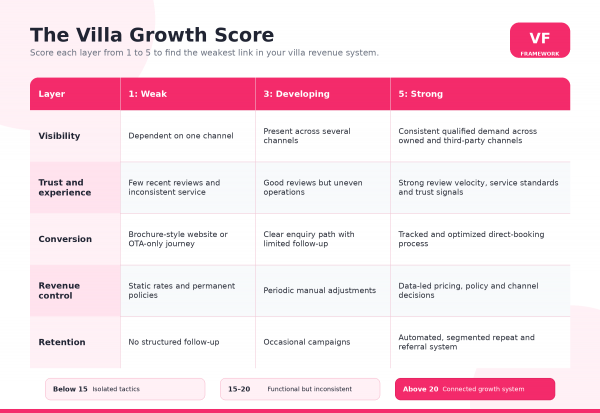
A business with strong visibility but weak conversion should not immediately buy more traffic. A property with solid bookings but falling review scores should address the experience before increasing acquisition.
Layer 1: Build Visibility Around Traveler Intent
Visibility is not about appearing everywhere. It is about appearing when the right traveler is looking for the experience the villa provides.
High-value villa searches are often specific:
- “Seminyak family villa with pool fence”
- “10-bedroom villa in Bali for a reunion”
- “Niseko chalet near beginner slopes”
- “Phuket wedding villa with staff”
- “Beachfront villa in Sri Lanka with private chef”
These searches reveal the purpose of the trip, not merely the destination.
A strong landing page should answer the needs behind the keyword. A family-villa page should cover bedroom layout, pool safety, cots, babysitting and meal arrangements. A group-villa page should explain communal space, bedroom fairness, transport and dining logistics.
Repeating “family villa” between photographs is not optimization. It is keyword confetti.
Create Content AI Systems Can Understand
A traveler may ask an AI tool:
“What is the best villa area in Bali for six adults and four children who want beach access, a private pool and help arranging meals?”
To be considered in that answer, a villa business needs clear, factual content explaining:
- Who the property suits
- Where it is located
- What is included
- Which problems it solves
- What guests value
- What services are available
- How it differs from nearby alternatives
This is often called generative engine optimization. In practice, it means publishing answer-ready information rather than vague promotional copy.
Important pages should use clear headings, concise definitions, factual descriptions, FAQs, internal links and structured data where appropriate.
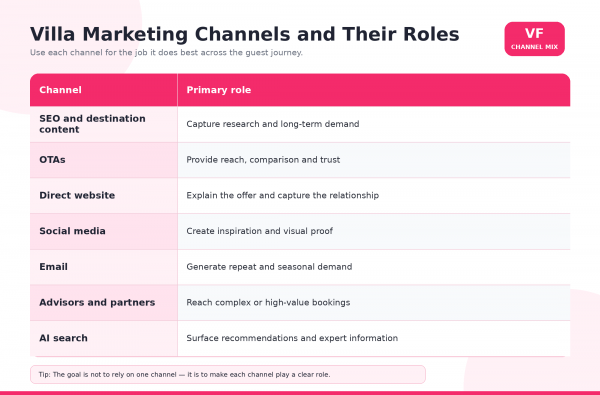
Give Each Channel a Role
Layer 2: Treat Trust and Experience as Revenue Levers
Villas carry more perceived risk than standardized hotel rooms.
Guests may be committing substantial money to a property they have never visited. They want to know whether the photographs are accurate, the neighborhood is suitable and support will be available.
Important trust signals include:
- Recent and verified reviews
- Accurate photography
- Clear inclusions
- Transparent booking terms
- Fast responses
- Professional payment processes
- Detailed location information
- Evidence of support during the stay
- Awards, certifications or media coverage where relevant
Gallagher argues that review scores should be treated as a revenue lever:
Our 2025 data shows that listings with a 4.9+ rating earn 16% higher RevPAR than the average, and the uplift compounds as booking platforms increasingly prioritize top-rated properties in search results. For villas, where guest expectations run highest and one missed message can cost you a star, consistent reviews are the most effective place to focus before adding another marketing channel.
A strong rating begins before the review request. It depends on accurate expectations, clear arrival instructions, pre-arrival communication, quality checks, fast service recovery and analysis of recurring complaints.
When asked what matters most now—better marketing, pricing, guest experience or direct booking—Gallagher’s answer was:
Guest experience, and it isn’t particularly close.
His reasoning is that a consistently high-rated villa is seen more often, converts more strongly, can command a premium and is more likely to generate repeat stays and referrals.
Marketing amplifies the experience the business already delivers. When operations are excellent, visibility creates momentum. When service is inconsistent, marketing simply introduces more people to the weakness.

What Does Villa Finder’s Experience Reveal About Reviews, Service and Revenue?
Villa Finder sees the same pattern in its own guest relationships, especially with families and groups. For these travelers, a villa stay is rarely just a place to sleep. It is often the main setting for the one big trip they have planned all year, which means trust, service and support carry real commercial weight.
Daniel Rouquette, CEO of Villa Finder, explains:
At Villa Finder, we’ve learned that the most reliable revenue strategy is simply caring for people. With over 70% of our guests being families—typically groups trusting us with their one holiday of the year—the stakes are incredibly high. They aren’t just buying a bed to sleep in; they are buying peace of mind.
We see this directly in our data: when guests utilize our Concierge to remove the mental load of a group trip—whether that means arranging pool fences, coordinating airport transfers, or booking a private chef—we don’t just see better reviews, we see higher return and referral rates.
But it goes deeper than that. When a property invests in its staff, supports the local community, and operates responsibly, the guest experience inherently transforms. This is a key differentiator in oversupplied markets like Bali. You cannot out-market a poor experience, because in the long run, your revenue is just a reflection of how well you honor your promises to your guests, your team, and the destination.
This is where villa growth becomes more than marketing. A responsive concierge team, well-supported villa staff, responsible operations and honest guest communication all shape the stay before they show up in the numbers.
Reviews, referrals and repeat bookings are not separate from the experience. They are the market’s response to it.
Layer 3: Turn Interest Into Direct Bookings
Visibility earns attention. Trust makes the guest comfortable. Conversion makes it easy to act.
A high-converting villa page should answer seven questions:
- Is this villa right for my group?
- What will the stay feel like?
- Where is it?
- What is included?
- Can I trust the operator?
- What support is available?
- What should I do next?
The best pages sell the outcome, not just the inventory.
“Six bedrooms” is a feature. “Six ensuite bedrooms, so every couple has equal privacy,” is a benefit.
“A fully equipped kitchen” is a feature. “A private chef can prepare dinner while the group enjoys sunset by the pool,” is an experience.
Why Is a Direct Booking Website Not Enough on Its Own?
Mark Simpson, founder of Boostly and a direct-booking expert for short- and medium-term rental operators, sees a common gap between launching a website and building a reliable direct-booking engine:
Most villa owners build a website, launch it and expect bookings to appear. That’s not a system—that’s a brochure gathering dust.
The real mistake is not capturing guest data. Every enquiry and every stay should go into an email list you own. After checkout, send an automated offer to book direct next time, then nurture that list with seasonal campaigns, early-bird offers and exclusive perks.
Direct bookings aren’t about having a fancy website. They’re about having a system that turns random guests into repeat customers.
A direct-booking system needs:
- Qualified traffic
- Strong property pages
- Accurate availability
- Transparent rates
- Mobile-friendly forms
- Clear direct-booking benefits
- Fast support
- Enquiry follow-up
- Guest-data capture
- Post-stay remarketing
The reason to book direct should be obvious. As Simpson puts it, that could mean a discount, more flexible cancellation or simply receiving an answer in 30 minutes rather than three days.
Other incentives might include priority support, loyalty credit or an exclusive service.
Operators should also identify where conversion fails. Are people viewing the page but not checking availability? Requesting quotes but not paying? Asking the same question repeatedly?
Each pattern points to a different issue. More traffic is not the cure for every leak.
Layer 4: Control Revenue Through Pricing, Policies and Distribution
A booking is not automatically a good booking.
Two villas can achieve the same occupancy and produce very different revenue. One may rely on discounts, high commissions and awkward stays. The other may attract higher-value groups, fill difficult gaps and retain the guest relationship.
Revenue control means influencing which bookings the business accepts and at what net value.
When Should You Change Minimum-Stay and Cancellation Policies?
Minimum stays and cancellation rules should not become permanent simply because they once worked.
Melanie Brown, VP of Data Analytics at KeyData, highlights the danger:
If your revenue is down, it’s probably not a great idea to keep a seven-night minimum requirement in a market that is moving towards five-night stays. Similarly, having the least flexible cancellation policy amongst your competitors will likely hurt your booking activity.
However, be sure to evaluate the trade-offs. Allowing shorter stays means you need to have a strategy to fill gap nights.
Reducing the minimum stay can unlock demand but create unusable gaps. Flexible cancellation can improve conversion but increase uncertainty. Last-minute discounts can fill an empty villa, but repeated discounting can train guests to wait.
Operators should regularly review:
- Average and median stay length
- Booking lead time
- Competitor policies
- Gap nights
- Weekday and weekend demand
- Seasonal booking pace
- Quote-to-book conversion
- Cancellation rates
- Net revenue after channel costs

What Is the Best Distribution Strategy for a Villa Business?
A healthy strategy does not necessarily remove OTAs. It prevents one intermediary from controlling the entire customer relationship.
OTAs can capture existing demand. The direct website protects margin and tells the fuller story. Email creates repeat demand. Advisors and partners may be better suited to complex group bookings.
The correct mix will differ by destination, property type and audience. Compare channels using net revenue, lead time, cancellation behavior, length of stay and guest quality—not booking volume alone.
How Can Villas Compete on Value Instead of Lower Prices?
Villas can increase value through services that remove coordination stress:
- Airport transfers
- Private chefs
- Grocery pre-stocking
- Drivers
- Babysitting
- Pool fencing
- In-villa wellness treatments
- Ski equipment and lift passes
- Celebration planning
- Private tours
- Group dining experiences
Guests are not simply buying bedrooms. They may be buying the confidence that a large group can arrive, eat, sleep and celebrate without one exhausted organizer managing every detail.
Layer 5: Build Repeat Demand Instead of Reacquiring Every Guest
The journey should not end at checkout.
Once a villa business has paid to acquire a guest, delivered a successful stay and earned trust, allowing that relationship to disappear is expensive.
A retention system can include:
- A thank-you message and review request
- A direct-booking offer for the next stay
- Personalized destination recommendations
- Early access to peak dates
- Seasonal campaigns
- Referral incentives
- Loyalty benefits
- Follow-up with guests who enquired but did not book
Segmentation matters.
A family that stayed in Bali may respond to a school-holiday campaign for Phuket. A ski group may want early access to Niseko chalets. A couple celebrating an anniversary should not receive the same message as a company planning a retreat.
Retention strengthens acquisition too. Repeat guests create reviews, referrals and branded searches. Those signals build trust, support conversion and reduce dependence on paid visibility.
This is where the growth system begins to compound.
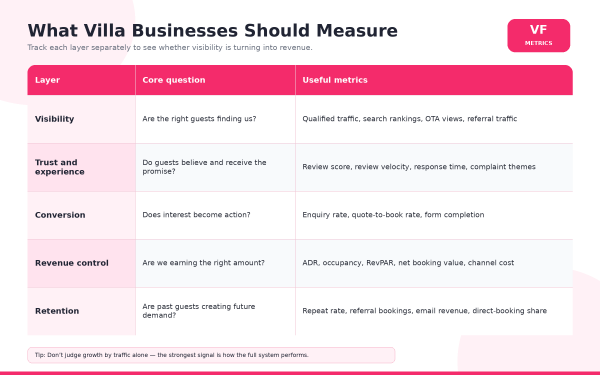
What Villa Businesses Should Measure
High occupancy can hide weak rates. Large traffic numbers can hide poor intent. A rising direct-booking share can still be unprofitable if acquisition costs are too high.
Measure each layer, identify the constraint and improve that first.
How Can You Grow a Villa Rental Business in 90 Days?
Days 1–30: Find the Leaks
Audit:
- Search visibility
- Property-page accuracy
- Review patterns
- Response times
- Booking steps
- Stay restrictions
- Cancellation policies
- Channel performance
- Guest-data capture
- Repeat-booking activity
Choose the two or three issues closest to revenue. Do not open five new marketing channels simply because visibility feels productive.
Days 31–60: Strengthen Trust and Conversion
Improve:
- Priority property pages
- Direct-booking benefits
- Mobile enquiry forms
- Price and availability clarity
- Pre-arrival communication
- Service checklists
- Review collection
- Enquiry follow-up
Track the effect on conversion and guest feedback.
Days 61–90: Improve Revenue and Retention
Test:
- Minimum-stay changes
- Gap-night strategies
- Early-booking and last-minute offers
- Channel performance
- Experience packages
- Post-stay campaigns
- Segmented email offers
- Referral or loyalty benefits
The goal is not to finish growth in 90 days. It is to establish a repeatable rhythm:
Measure, improve, test and learn.

A Real Villa Growth Framework Case Study
Villa Lapis 1 had many of the ingredients guests look for: a central location in Berawa, a private pool and a modern, family-friendly design. Yet the property was not performing at its potential.
In 2024, occupancy averaged just 43.9%, with no bookings recorded during some months. Nine months after Villa Finder took over its commercial strategy, gross booking value had increased by 49.3%, while occupancy rose substantially over the comparable period.
What Was Preventing the Villa From Growing?
The problem was not the villa itself. It was the system around it.
The property was being managed with:
- Static pricing that did not respond to changing demand
- Distribution limited mainly to Airbnb
- Manually updated calendars
- Smartphone photography and generic descriptions
- Reactive rather than proactive performance monitoring
- No structured sales, guest-support or concierge process
The villa was visible, but only within a narrow part of the market. Its pricing and positioning were also not adapting quickly enough to traveler demand.
Which Part of the Villa Growth Framework Needed the Most Attention?
The weakest layers were visibility and revenue control.
Depending on one booking channel restricted the number and types of travelers the villa could reach. At the same time, manually set rates made it difficult to respond to changes in demand, competitor pricing and last-minute booking opportunities.
Conversion and guest experience also needed support. The listing did not clearly communicate the villa’s strongest qualities, while the owner was managing enquiries, calendars and guest needs without a dedicated support system.
What Did the Villa Finder Team Change?
Villa Finder introduced a connected commercial strategy rather than relying on one isolated fix.
The team:
- Adjusted pricing using daily market monitoring, competitor data, PriceLabs and AirDNA
- Expanded distribution to 15 booking channels, a direct website and more than 1,500 global travel partners
- Automated calendar synchronization to reduce errors and maximize availability
- Repositioned the villa with professional photography and descriptions aimed at families and stylish groups
- Monitored occupancy, revenue and market conditions in real time
- Added 24/7 travel-consultant suport and post-booking concierge service
Each change addressed a different layer of the Villa Growth Framework, but the improvements worked together.
What Happened After the Changes Were Made?
Over the comparable reporting period:
- Average occupancy increased from 48.4% to 74.1%
- Gross booking value rose from USD 29,556 to USD 44,120
- Revenue increased by 49.3% year over year
- July delivered a record USD 9,041, the villa’s highest monthly revenue
The property achieved this growth despite nearby construction that could have weakened demand.
The lesson is simple: the villa did not need visibility alone. It needed wider distribution, responsive pricing, stronger positioning and continuous performance management working as one system.
Read the complete Villa Lapis 1 revenue-growth case study for a detailed breakdown of the strategy and results.
The Future of Villa Growth Is Connected
The villa businesses that grow in 2026 will not necessarily have the largest advertising budgets or the widest distribution.
They will build visibility around real traveler intent. They will treat reviews and service as commercial assets. They will make direct booking easy and worthwhile. They will adjust rates and policies as demand changes. And they will maintain the relationship after checkout.
That is the Villa Growth Framework:
Be discovered. Earn trust. Make booking easy. Control the value. Keep the relationship.
Visibility may open the door. The system determines how much revenue walks through it.