

Bali’s villa market is booming. International arrivals are climbing back up nearly 14% year-on-year in the first half of 2025 and demand for luxury stays strong. On the surface, it looks like paradise for owners, managers, and investors.
Scratch a little deeper, though, and the picture is less idyllic. Oversupply is hitting hard, discounts are ballooning, and average booking values are shrinking. Guests are spoiled with choices, platforms like Airbnb are pulling ahead, and “last-minute” is no longer a quirk but a defining booking behaviour.
If you’re in this market, you can’t rely on pretty photos and hope for the best. Winning in 2025 means playing smarter, not cheaper.
An Event Built for Real Conversations

These insights didn’t come from a boardroom memo or a theoretical paper. They came from a room of villa owners, managers, and industry leaders gathered at Villa Finder’s Bali office on August 21, 2025.
The event, Standing out in Bali’s Villa Market, was designed less as a seminar and more as a candid conversation. Twenty-one villa owners joined Villa Finder’s Head of Distribution, Jolien Keulen, and Johannes Marbun, COO of Bookandlink, to unpack the numbers and share what’s actually working in today’s market.
By the first slide, the tension was obvious: more than 3.3 million international arrivals in the first half of 2025, yet booking values were down by 21.6%. Supply is outpacing demand, and owners are feeling the squeeze.
“This is one of the biggest blocking points,” one owner admitted during the discussion on oversupply. Heads around the room nodded in agreement.
What followed was a frank discussion on how to adapt, not just with discounts, but with smarter positioning.
2025 Market Snapshot: Strong Arrivals, Weak Margins

Let’s start with the numbers.
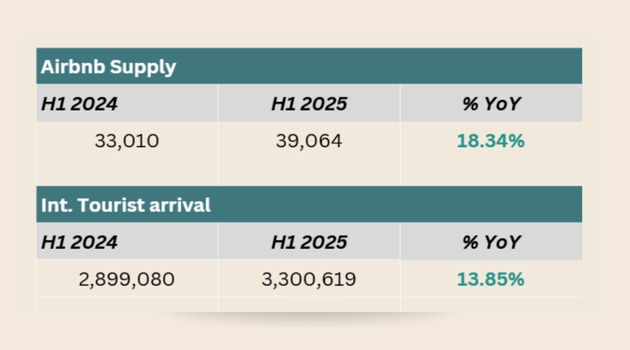
- International arrivals: 3.3 million Jan to June 2025 (+13.9% YoY). Australia leads, followed by India, China, South Korea, and the UK. Demand is there.
- Airbnb supply: Up 18% YoY, now topping 39,000 listings. Oversupply is outpacing even the growth in arrivals.
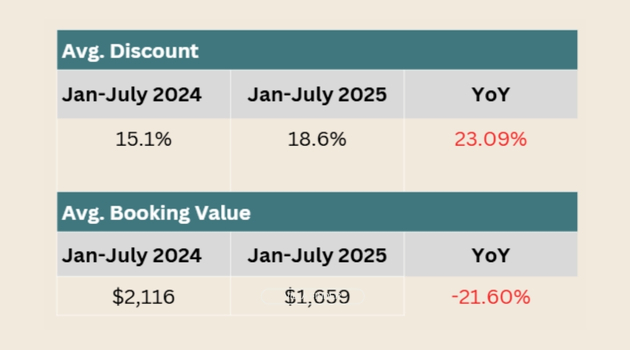
- Discounting: Average discount rates jumped from 15% in 2024 to nearly 19% in 2025. Guests have been trained to wait for deals.
- Booking values: Down 21.6% YoY. Guests are spending less per stay, despite Bali’s popularity climbing.
This is the paradox of 2025: more travellers, yet thinner margins. Owners and operators are trapped in a race to the bottom unless they find ways to stand out.
What This Means for Owners, Managers, and Investors
- Owners
Profitability is being squeezed from both ends. On one side, nightly rates are stagnating as oversupply forces more aggressive discounting. On the other hand, operating costs: from staffing to electricity to government compliance, continue to rise. Owners who rely on “set and forget” pricing models or generic marketing will see margins erode. The path forward is to treat the villa like a business, not a hobby: invest in brand identity, professional photography, reputation management, and long-term guest relationships that justify higher rates. - Managers
In today’s market, managing a villa isn’t just about keeping the property clean and the pool sparkling. Managers face the much harder challenge of differentiation in a landscape flooded with thousands of near-identical listings. Dropping prices might fill nights, but it weakens positioning and hurts long-term profitability. The winning managers are those who build clear, unique selling points for each property, such as family-friendly design, wellness retreats, eco-certified operations, or proximity to experiences, and align them with the right distribution channels. - Investors
The passive-investment era is over. Buying a villa in Bali and assuming occupancy will “just happen” automatically no longer works in a saturated market. Investors must approach acquisitions with a sharper eye on positioning, distribution strategies, and operational excellence. Returns will increasingly depend on how intelligently the villa is marketed and managed. Those who rely solely on location or aesthetics without a clear business plan will struggle to hit expected yields.
The message is clear: Bali isn’t short on demand, it’s now oversaturated with supply. Success won’t come from building the biggest villa or undercutting neighbours on price. It will come from strategy: sharper positioning, diversified distribution, and disciplined management. In this market, it isn’t scale that determines who thrives, but how intelligently each property is run.
Growing Profits in 2025: Play Offense, Not Defense

Instead of reacting to market turbulence, stakeholders should lean into strategies that increase both visibility and perceived value.
- Add services and experiences
Guests are no longer satisfied with “just a villa.” Package deals, curated local experiences, and value-added services such as in-house private chefs or wellness sessions transform a booking into an experience and create lasting memories. That’s what gets five-star reviews and repeat visits. - Make reviews your currency
High ratings don’t just attract more bookings; they justify higher rates. Invest in service quality, quick responses, and personalised touches. Guests will pay more if they trust they’ll get more. - Diversify your channels
Over-reliance on a single OTA is a risky play. Different platforms bring different audiences. Rate parity matters, but so does visibility. Work with multiple OTAs and use a channel manager to avoid double bookings and chaos. - Smart pricing beats blind discounting
Dynamic strategies are essential. Dropping rates is not always enough; you need to track demand patterns, competitor pricing, and booking windows. Aim for tactical promotions, not desperate markdowns.
Airbnb: The Benchmark You Can’t Ignore
Love it or hate it, Airbnb has become the default reference point for how guests expect a villa stay to look, feel, and be booked. Their dominance is not accidental—it rests on four pillars:
- Global recognition and trust — travelers feel safe booking on Airbnb, even in unfamiliar destinations.
- Guest-friendly financial guarantees — flexible cancellation policies and payment protection reduce perceived risk.
- A deep review ecosystem — credibility comes from thousands of guest voices, not just glossy marketing copy.
- Professional branding and consistent standards — the platform trains guests to expect quality and transparency.
Independent villas may not be able to compete on sheer brand power, but they can adopt the same habits that feed Airbnb’s algorithm and convert browsers into bookings. The most successful operators act less like casual hosts and more like professional hoteliers. That means:
- Speed matters. Respond to inquiries within minutes, not hours. Airbnb rewards fast replies with higher visibility.
- Zero tolerance for cancellations. Cancel once, and you risk your ranking. Guest trust is non-negotiable.
- Visual storytelling. Professional photography, well-lit images, and a mix of wide shots and detail close-ups sell an experience, not just a room.
- Copy that sells. Descriptions should highlight unique selling points clearly—whether it’s a rooftop infinity pool, walking distance to beach clubs, or eco-certification.
Two Quick Wins for Your Airbnb Listing
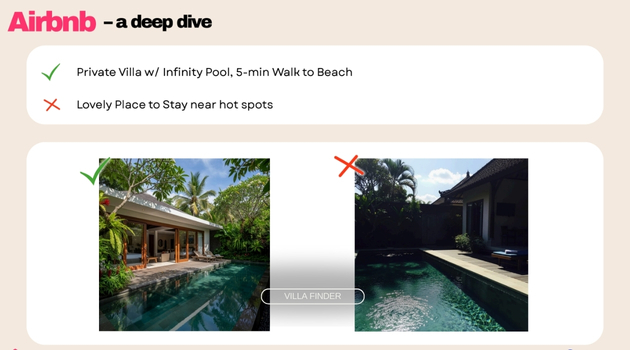
- Upgrade your visuals.
Professional photos aren’t optional anymore—they are your storefront. Airbnb’s algorithm prioritizes listings with high-quality images, and guests will scroll past grainy, poorly lit shots. Invest in a proper shoot that captures both the property and the lifestyle it offers. - Experiment with your title.
The listing title is your headline. A small tweak can shift visibility dramatically. Don’t be afraid to test different angles—emphasizing location (“5-Min Walk to Seminyak Beach”), amenities (“Rooftop Pool & Sunset Views”), or guest type (“Family-Friendly 4BR Retreat”). If exposure drops, refresh the title and monitor the impact.
Looking Ahead to 2026: Adapt or Fade
If 2025 is about survival, 2026 will be about positioning for the next wave of change. Demand for Bali remains strong, but the market will reward those who anticipate shifts before they become mainstream. Three themes deserve special attention:
1. Sustainability as Standard
Sustainability has moved beyond buzzword status—it’s now a commercial differentiator. According to Booking.com, 83% of global travelers say sustainable travel matters to them, and 20% of Trip.com users are willing to pay more for certified properties.
For owners and managers, this isn’t just about adding a recycling bin. It means investing in certifications, highlighting eco-practices in listings, and communicating the impact to guests. Platforms like Villa Finder and major OTAs increasingly give sustainable properties preferential exposure. The villas that align with this shift will capture both visibility and pricing power.
Action point: Audit your property for sustainability opportunities, energy use, waste management, local sourcing and position your villa as part of the solution, not the problem.
2. AI Creeping Into Operations
AI is becoming a core part of how competitive villas will be run in 2026. Owners and managers who rely entirely on manual processes are already falling behind those who automate intelligently.
Where AI is making the biggest impact:
- Guest communications
Guests expect instant replies, not responses “within 24 hours.” AI-powered chatbots and automated messaging systems can answer FAQs, confirm availability, or share check-in details instantly. This not only improves guest experience but also boosts rankings on OTAs like Airbnb and Booking.com, where speed of response is a key algorithm factor. - Revenue management
Predictive pricing tools are replacing gut feel. These systems analyse competitor rates, market demand, seasonality, and booking windows to recommend daily price adjustments. No more underpricing during peak weeks or overpricing during quiet seasons, villas that adopt revenue automation now will protect margins while competitors scramble to keep up. - Operations & cost control
Smart systems can monitor electricity and water use, flag maintenance issues, and even help schedule staff shifts. These efficiencies matter in Bali’s climate of rising labour and utility costs, where shaving a few percentage points off operating expenses can make the difference between profit and loss. - Content that AI can “read”
Increasingly, guests don’t search directly—they ask AI-driven travel planners or booking assistants for recommendations. If your villa website or OTA listing isn’t structured in a way that AI tools can easily interpret (clear descriptions, metadata, schema markup, sustainability labels, and consistent branding), you risk being invisible in this new discovery layer. Think of it as SEO for the AI era: if the machine can’t understand your content, it won’t show it to potential guests.
AI can never replace human hospitality; it supports humans to deliver it better. Owners who embrace automation can focus staff attention on creating memorable guest experiences rather than chasing down routine tasks.
Action point: Start small. Integrate an AI-driven chatbot for faster guest responses or test a dynamic pricing tool for one villa. Once the ROI is proven, expand adoption across your portfolio. Waiting carries its own cost: in lost visibility, lower margins, and missed bookings.
3. Legal and Compliance Readines
Regulation is no longer an abstract threat. As Bali grapples with overtourism, housing affordability, and community tensions, policymakers are tightening the screws on short-term rentals. Licensing, zoning, and taxation are no longer gray areas—they are fast becoming red lines.
For villa owners and investors, the compliance checklist typically includes:
- Business Licensing (NIB & OSS): Every villa operating commercially must have a business identification number (NIB) registered through the Online Single Submission (OSS) system.
- Accommodation Licensing: Depending on your villa’s size and classification, you may need permits under Indonesia’s Pariwisata (tourism) regulations. Local governments often apply slightly different interpretations, so requirements can vary by regency.
- Zoning & Building Permits (IMB/SLF): Villas must comply with local zoning laws (RTRW) and hold the correct building-use permits. Some areas of Bali restrict short-term rental activity outright.
- Tax Compliance: Owners are responsible for collecting and reporting VAT (Value-Added Tax) and service charges, as well as paying corporate income tax if operating under a company structure. The Directorate General of Taxes is now actively monitoring OTA data to cross-check reported revenue.
- Employment Law: Staff contracts, minimum wage compliance, and social security contributions (BPJS Ketenagakerjaan and BPJS Kesehatan) are mandatory for employed villa staff.
- Environmental Permits (AMDAL/UKL-UPL): Larger villas or those in sensitive areas may require environmental approvals related to waste management and water usage.
Where to stay updated:
- Dinas Pariwisata (Tourism Department): Local regency offices publish tourism-related rules and licensing updates.
- BKPM / OSS Indonesia: For business registration and NIB issuance.
- Directorate General of Taxes (DJP): Official updates on VAT and corporate tax obligations.
- Local notaries & legal consultants: Critical partners for interpreting how national rules are applied regionally in Bali.
Action point: Don’t assume what worked in 2023 still holds in 2026. Conduct a legal health check on your villa operations now—permits, tax filings, zoning approvals—and make compliance a core part of your investment strategy, not an afterthought.
The Bottom Line
Bali’s villa market isn’t collapsing—it’s evolving. The winners won’t be the ones with the flashiest designs or the deepest discounts, but the ones who adapt quickly, add real value, and embrace strategy over guesswork.
For owners, managers, and investors, the message is simple: don’t wait for the market to “normalize.” It won’t. Act now, differentiate clearly, and you’ll do more than survive Bali’s crowded villa landscape—you’ll stand out in it.
And if this August’s gathering proved anything, it’s that owners want space to have these conversations together—not in isolation. That’s why Villa Finder will continue hosting in-person events in 2026, bringing the industry into one room to face challenges head-on and share strategies that actually work.
To dive deeper into the insights we shared during the event, you can download the full presentation here.
Interested in joining our next Villa Finder event in 2026?
Sign up here to be the first to know when registrations open: Villa Finder Owners Event – RSVP
Related Articles:
Is It Too Late to Invest in Bali in 2025?
The Rupiah Rule: A Must-Know for Every Property Owner in Indonesia
Are OTAs Helping You or Owning You?





Comments are closed.