
As Bali continues to grow as a global tourism and business destination, so does its energy demand. But behind the island’s beauty lies a serious environmental challenge: most of Indonesia’s electricity still comes from coal, one of the dirtiest fossil fuels!
In response to this, our office in Bali has installed solar panels (also known as a photovoltaic or PV system), a clean, renewable energy solution that can reduce our dependence on fossil fuels and won’t harm our air quality. Here’s how we’re installing our solar panels, why it’s urgent in the context of Indonesia, and how others can follow our path.
Why We Consider Using Solar Panels
We decided to install solar panels based on a combination of practical, environmental, and ethical considerations.
1. Rising Electricity Costs
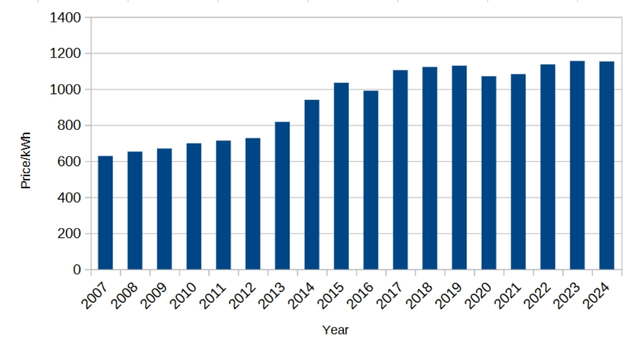
Electricity rates in Indonesia have been gradually increasing, especially for commercial users. In Bali, where many businesses rely on air conditioning, computers, lighting, and refrigeration, monthly utility bills can add up quickly. Solar panels allow us to reduce operating expenses and protect against future rate hikes. Below is a graph that shows the average electricity tariff in Indonesia collected from several sources.
2. Indonesia’s Coal-Dominated Grid
Indonesia still generates around 60% of its electricity from coal (VOI, 2024). This means that even if our office already uses efficient electronic appliances, the power we use comes from a carbon-intensive source. By switching to solar panels, we significantly reduce our indirect emissions.
Fun fact – Producing 1 kWh of electricity on coal power (0.91 CO2-eq) that can be used for turning on AC for 55 minutes.
3. Bali’s Ideal Climate for Solar Energy
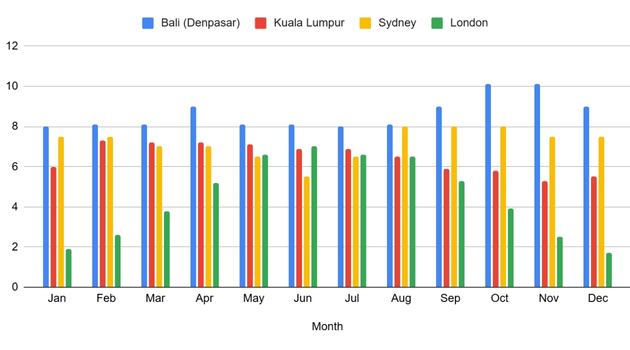
As a tropical destination that is located near the equator, Bali enjoys strong sunlight throughout the year, making it a perfect location for solar energy. Solar systems in Bali are highly efficient and generate reliable output, even during the rainy season. Below are the data that were collected from weather2travel.com, live.weather2visit.com, and weather atlas show the average daily sunlight in several areas
4. Compliance with the Government Target and International Commitment
By installing solar panels, we align our operations with the Bali Provincial Government’s target to increase renewable energy use (Regulation No. 45/2019), support the UN Sustainable Development Goals (SDGs), particularly SDG 7 (Affordable and Clean Energy) and SDG 13 (Climate Action), and uphold our commitment to the Glasgow Declaration on Climate Action in Tourism. This step not only reduces our carbon footprint but also reinforces our role in building a more sustainable future for Bali and beyond.
5. Living Our Sustainability Values
As a company committed to responsible travel and environmental stewardship, switching to solar demonstrates our values in action and builds trust with eco-conscious partners, guests, and employees. See our sustainability report for more information about our commitment to sustainability!
Step-by-Step: Installing Solar Panels in Our Bali Office
As we have just finished installing solar panels in our offices, we want to share our lessons learned with others to gain a real understanding of how to install solar panels. Please note that the Indonesian government has a quota for owners who want to install solar panels, which only opens in January and July. From start to finish, the entire process can take up to six months.
Here is the list of things you need to know and do:
1. Energy Audit
In November and December, we began with a detailed audit of our office’s electricity consumption. This helped us size the system accurately. If you plan to add new electronic appliances, make sure to include them in your calculation so you can estimate the increase in electricity use. It’s also worth considering replacing older devices with energy-efficient ones, since this can reduce overall demand and allow you to install a smaller, more cost-effective solar system.
Furthermore, once you have the number, you can convert it into kWp to gain a better understanding of how many solar panels need to be installed. For instance, a typical office using 1,000 kWh per month would require a solar panel that can produce an 8–10 kWp solar system to offset a major portion of its electricity use. For a more detailed calculation, you can calculate it by yourself via this link.
Once you know how many solar panels can be installed, you can consider using off-grid (solar panel dependency) or on-grid (still using electricity from PLN but reducing the dependency on fossil fuel) systems of solar panels for your building. If you are so confident, you can use off-grid solar panels; however, you need to consider that your solar panel can produce twice as much of your consumption to mitigate the shortage when there is no sun or cloudy, and batteries to store the electricity.
2. Choosing a Licensed Installer
After all the information you have, it is time to find the best vendor that can install the solar panel. They must have:
- Certified under the Indonesian National Standard (SNI)
- Offers systems with a 10–25 year warranty
- Has experience navigating PLN interconnection processes
- Assisting with all the legal processes until the solar panel can be used legally.
Note: You can contact a few licensed installers for a comparison. We have already shortlisted some of them that we trust. It is important to ask the number of installed panels, layout systems, estimated timeline, energy saving, and ROI (usually the expected payback period is around 4-7 years).
3. Site and Roof Assessment
After calculating how many solar panels are needed to meet your electricity demand, the next step is to check how many panels can actually fit on your roof. In this process, we take two weeks to complete it, and all the processes are handled by the solar panel consultant. You should also consider factors such as roof size, angle, orientation, shading, and structural strength to ensure your solar system produces the maximum possible electricity:
- Enough sunlight exposure (ideally north-facing in the Southern Hemisphere)
- Minimal shading from nearby buildings or trees. Placing solar panels that are affected by shadows will reduce their overall production and lifetime.
- Structural integrity and racking systems needed to be considered, as the solar panels are quite heavy. When the weather is windy, they are not blown off and take your roof with them.
4. Installation
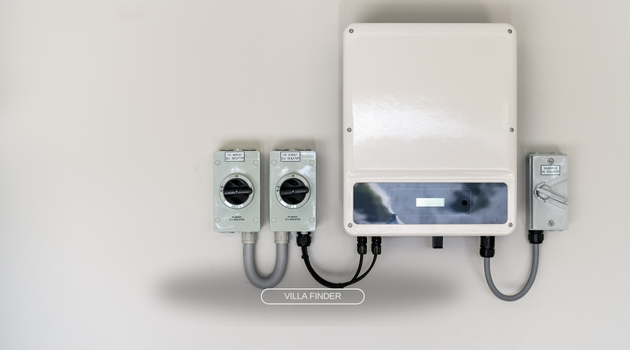
Once you have confirmed that you wish to continue the process. The contractor will continue the installation process. This process is taken for 2 months (March to May which includes:
- Panel mounting on roof rails (2 weeks)
- Wiring, inverter, and electrical integration (2 weeks)
- Safety testing and smart monitoring setup. (3 weeks)
Note: We suggest that you do this step in parallel with the permits and PLN approval process, as it will help reduce the timeline to achieve the permits.
5. Permits & PLN Approval
Navigating the legal and regulatory process for solar panel installation in Indonesia can be challenging—but it’s definitely not impossible. It needs three months (April – June) to ensure all the permits and PLN approval. Several administrative steps must be fulfilled to comply with national and utility regulations:
- Register on PLN’s mobile app to apply for solar panel installation.
- Obtain the Electrical Power Installation Identity Number (NIDI) for your solar system.
- Secure the Certificate of Operational Eligibility (SLO).
- Prepare and submit all required documents for both PLN and the Ministry of Energy and Mineral Resources. (This step is typically supported by your installation vendor or consultant.)
- Undergo a site visit by the Ministry of Energy and Mineral Resources to ensure that all installed components match the registered specifications and quality standards.
- PLN will conduct a site inspection to verify that the solar system operates properly and efficiently.
- If everything is in order, PLN will approve and activate your system. However, if there are issues such as production levels being below expectations, PLN may conduct follow-up inspections.
Important Note: In some cases, if you are planning to upgrade your electricity capacity, please finish this step first before proceeding with permits and PLN approval for the solar installation. Additional documents and fees may also be required, depending on your specific situation..
7. System Monitoring
Once it is installed and connected, the contractor will inform us to connect with a mobile app to track real-time power production, information if there is any faults or maintenance needed. This also helps us calculate monthly carbon savings! In 29 days, we have already produce 2.7 MWh and it is similar to what 117 trees would have taken a lifetime to absorb.
The Impact on Our Operations
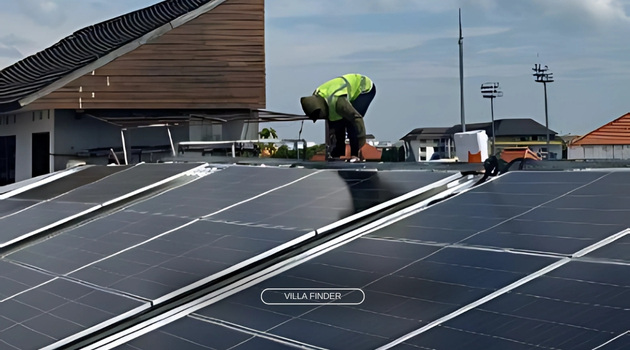
Since going solar at the end of June 2025, we’ve seen:
- Up to 50% reduction in monthly electricity costs.
- Generating 2.7 MWh approximately avoids 2.7 metric tons of CO₂-eq emissions, which is similar to planting 117 trees.
- Positive response from team members, partners and guests who value sustainability
More importantly, we now contribute less to Indonesia’s coal dependency and help to improve our air quality!
Our Insight
A lot of you will think that installing solar panels will require a lot of investment in the first place. However, with the payback period around 6 and 7 years and the impact and engagement to the public is real. We’ve provided a calculator to help you calculate your return on investment and payback period in this link.
Feel free to contact us; we are happy to share our learnings for further discussion to achieve sustainable tourism.
Related Articles:
Stress-Free Sustainability for Your Villa: Use Our Free Policy, Environmental Calculator, and More!
Sustainable Villas: How to Attract Eco-Conscious Travelers and Future-Proof Your Property
Blending Tradition and Technology: The Smart Way to Make Your Villa More Sustainable





Comments are closed.