
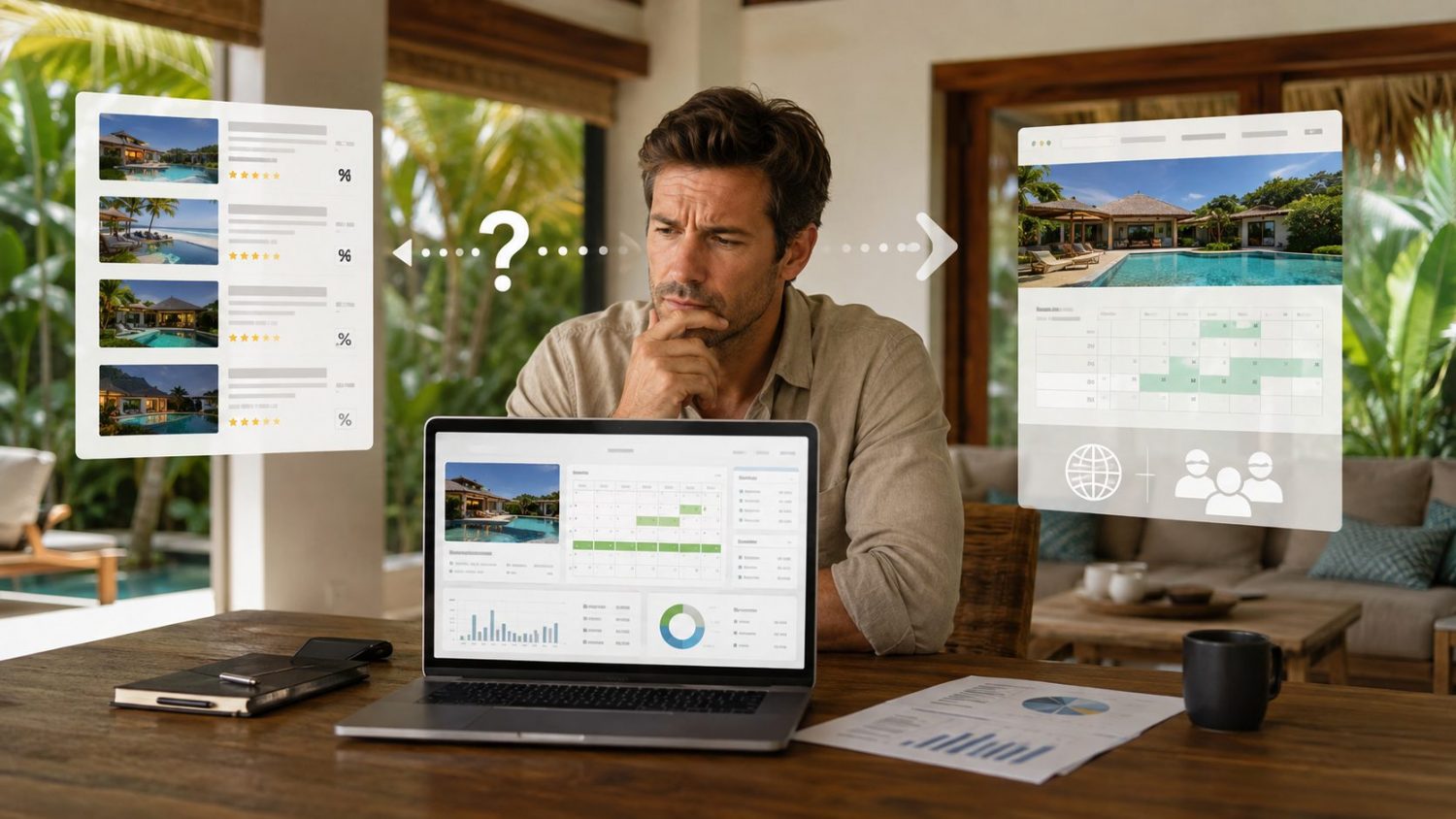
For villa owners, the debate around OTA vs direct bookings often sounds deceptively simple. An online travel agency charges commission. A direct booking does not. Therefore, direct bookings must be more profitable. And in many cases, that is true.
If a past guest comes back to you directly, someone recommends your villa to a friend, or a traveller finds your website and sends an enquiry, the cost of that booking may be very low. Apart from your website, payment processing and perhaps a small direct-booking incentive, there may be little additional cost.
But there is another question that matters just as much: How many bookings can you generate that way?
OTAs charge commission because they solve a different problem. They give your villa access to travellers who may never have heard of your property, your brand or even your destination before starting their search.
So the useful question is not: “Should I choose OTA or direct bookings?”
It is: “Which channels bring me profitable bookings, and how dependent am I on any one of them?”
That is where the real business decision begins.
OTA vs Direct Bookings: Which Is More Profitable?
There is no universal winner. A direct booking from a repeat guest can be extremely profitable because very little marketing may be required to generate it.
An OTA booking, meanwhile, comes with commission—but it may also introduce a completely new guest whom you would never have reached on your own.
That means the value of a booking channel should not be judged on commission alone.
A more useful question is:
How much revenue does the booking leave after the costs that are specific to that channel?
You can think of this as channel contribution:
Channel contribution = realized booking revenue − channel-specific costs
For this comparison, you do not need to include expenses that are broadly the same regardless of how the guest booked, such as housekeeping or utilities.
Focus on the costs that actually change depending on the booking source.
What Do OTA Bookings Really Cost?
OTA costs vary by platform, market, programme and individual property agreement.
At the time of publication, Airbnb says that most hosts using its single-fee structure pay 15.5%, while most remaining hosts on that structure typically pay between 14% and 16%. Airbnb also says that this single-fee structure is mandatory for certain hosts, including hosts using property-management software.
Booking.com also operates on a commission model, but there is no single universal commission percentage that should be assumed for every accommodation provider. Its accommodation partner terms state that commission is calculated using the relevant percentage set out in the property’s individual agreement.
Booking.com also says properties participating in programmes such as Preferred Partner pay higher commission in exchange for additional visibility.
The important number, therefore, is not an industry average. It is your own contracted cost.
If your OTA costs you 15%, use 15%. If it costs you 18%, use 18%.
Then ask a more useful question: What am I receiving in return for that commission?

What Are You Actually Paying an OTA For?
An OTA commission is not simply a fee for processing a reservation. A major part of what you are paying for is access to demand.
Depending on the platform, that can include:
- Travellers already searching for accommodation
- International reach
- Marketplace visibility
- Booking infrastructure
- Reviews and traveller trust
- Marketing reach that may be difficult for an individual property to reproduce
This is particularly relevant for independent villa owners.
A large booking platform can invest in advertising, search visibility, technology and brand recognition on a scale that an individual villa usually cannot.
That does not mean every OTA booking is automatically worth its commission.
But it does mean the right question is not: “Is 15% expensive?”
It is: “Is this platform generating profitable bookings that I would otherwise struggle to win?”
If the answer is yes, commission can simply be the cost of acquiring additional demand.
Are Direct Bookings Cheaper Than OTAs? Often, Yes.
Consider the easiest type of direct booking: a repeat guest.
Imagine your villa is available for $8,000.
If that guest books through an OTA charging a hypothetical 15% commission:
$8,000 × 15% = $1,200 commission
That leaves:
$6,800
before the operating costs that would exist regardless of channel.
Now imagine the same guest contacts you directly instead.
If the only additional direct cost is $200 in payment processing:
$8,000 − $200 = $7,800
In this situation, direct clearly performs better.
That is why repeat bookings, referrals and guests who already know your villa are so valuable. You do not need to pay a platform to introduce you to a customer you already have.
But this is also where the direct-versus-OTA discussion often becomes misleading. The economics change when you want to generate more direct bookings from people who do not already know you.
When Does a Direct Booking Strategy Start Costing More?
If individual villa owners want to scale direct bookings beyond repeat guests and referrals, they may eventually need to invest more heavily in attracting new travellers.
That could include:
- A better website or booking engine
- SEO and content
- Paid search
- Paid social advertising
- Email or CRM tools
- Specialist marketing support
Not every villa owner uses these today, and not every property needs all of them.
But if direct bookings are expected to become a meaningful source of new customer acquisition, someone has to create that demand.
That is where the breakeven calculation becomes useful.
The Breakeven Math Every Villa Owner Should Know
Let’s use another simple example.
The following figures are illustrative only. They are not Villa Finder averages or industry benchmarks.
Imagine your villa receives an $8,000 OTA booking at a hypothetical 15% commission.
The OTA cost is:
$8,000 × 15% = $1,200
That leaves:
$6,800
Now imagine you could receive the same $8,000 booking directly.
Suppose the direct booking involves:
- Payment processing: $200
- Booking technology: $80
- Other attributable direct costs: $100
Total before marketing:
$380
That leaves:
$8,000 − $380 = $7,620
Compared with the OTA’s $6,800, you have a difference of:
$820
That means, in this simplified example, you could spend up to $820 acquiring that new guest directly before the direct and OTA channels produced roughly the same contribution.
If attracting that customer directly costs you $300, direct performs better.
If it costs $700, direct still comes out slightly ahead.
If it costs $1,000, the OTA would actually have been the more economical route.
This does not mean villa owners should start spending hundreds of dollars acquiring every direct booking. It simply gives you a way to judge whether investing in direct marketing makes financial sense.
Instead of saying: “OTA commission is expensive.”
You can ask: “Could I realistically acquire this guest myself for less?”
That is a far better business question.

Not All Direct Bookings Cost the Same
There is another complication. Imagine three guests booking the same villa.
- Guest A stayed with you last year and contacts you again.
- Guest B hears about the villa from a friend.
- Guest C has never heard of your property and discovers it through a paid advertising campaign.
All three may appear as “direct” bookings in your reporting. Economically, they are completely different.
- Guest A may cost almost nothing to reacquire.
- Guest B may arrive through a referral with very little marketing cost.
- Guest C might require a much larger investment.
This is why owners should avoid treating all direct bookings as identical.
The most valuable direct strategy may not be trying to make every first-time traveller book directly.
It may be making sure that once a guest has discovered and enjoyed your villa, their next booking becomes much easier and cheaper to win.
Measure Stayed Revenue, Not Just Bookings Created
There is another small but important detail when comparing channels. Use realized or stayed booking revenue where possible, not simply the value of reservations created.
Why? Because a $10,000 booking that later cancels is not economically equivalent to a $10,000 booking where the guest actually stays.
A channel might appear to generate huge booking value while also generating more cancellations, refunds or no-shows.
HSMAI recommends analysing actual stayed bookings, net revenue and distribution costs when assessing channel performance.
So instead of only asking: “Which channel generated the most bookings?”
Ask: “Which channel generated the most valuable stayed business?”
Can You Offer a Better Rate for Direct Bookings?
This depends on the OTA agreement and regulations applying to your property.
Rate-parity requirements differ by platform and jurisdiction, so villa owners should check their current agreements before publicly offering a lower direct rate.
*Rate parity refers broadly to arrangements governing whether accommodation providers can offer different prices or booking conditions across different distribution channels.
But direct bookings do not necessarily need to compete purely on price.
Depending on the applicable rules, owners may be able to offer extra value through things such as:
- Greater flexibility
- Repeat-guest benefits
- Added services
- Transfers or other inclusions
- More personalised booking support
The aim is not simply to make direct cheaper. It is to give guests a good reason to book directly while protecting the value of the reservation.
What Are the Risks of Relying Too Much on OTAs?
Commission is easy to see. Dependency is harder.
Suppose one OTA gradually becomes responsible for most of your bookings.
- ✔️ Occupancy is strong.
- ✔️ Revenue looks healthy.
- ✔️ Nothing appears wrong.
But then the platform changes its ranking system.
- ❌ Your visibility drops.
- ❌ Competition in your destination increases.
- ❌ A commercial programme changes.
- ❌ Or your account temporarily faces an issue that affects bookings.
You do not need an OTA to disappear completely for dependency to become expensive.
Booking.com, for example, says its accommodation ranking takes into account factors including click-through rate, bookings, reviews, availability, pricing and content. It also says factors such as commission level and participation in programmes such as Genius or Preferred Partner can influence ranking.
This does not make OTAs inherently problematic. Every marketplace needs a way to decide what guests see.
The problem starts when too much of your business depends on visibility you do not control. If that sounds familiar, we’ve explored this risk in more detail in our guide to reducing OTA dependency and building a more diversified villa distribution strategy.

How Can Villa Owners Diversify Their Booking Channels?
Reducing OTA dependency does not mean removing every OTA listing. That could simply replace distribution risk with a demand problem.
A better objective is to reduce the property’s vulnerability to any single source of bookings.
For an individual villa owner, that can be relatively simple:
- Maintain a trustworthy direct website or enquiry channel
- Make it easy for previous guests to return
- Encourage referrals
- Track where stayed bookings actually come from
- Work with more than one distribution partner
- Avoid letting one platform account for an uncomfortable share of revenue
- Invest more heavily in direct marketing only when you can measure whether it works
You do not need every channel to generate the same number of reservations.
Different channels can do different jobs.
An OTA may be excellent at introducing your villa to first-time international travellers.
Your direct website may work best for past guests and referrals.
A specialist villa platform may reach a particular market or type of traveller that your own marketing does not.
The point is to build a mix rather than forcing one channel to do everything.
OTA vs Direct Bookings: You Probably Need Both
There is no prize for reaching 100% direct bookings. And there is no reason to pay OTA commission on every guest if you already have strong repeat and referral demand.
For most villa owners, the sensible strategy sits somewhere in the middle.
- Use direct bookings where you already have a relationship with the guest or can acquire demand efficiently.
- Use OTAs and specialist partners where their reach can introduce you to profitable customers you would otherwise struggle to find.
And keep an eye on how dependent your business becomes on any single source.
In the end, villa owners should be able to answer three questions:
- How much does each booking channel actually cost me?
- Is the channel bringing me bookings I would otherwise struggle to generate?
- What would happen if my biggest source of bookings suddenly slowed down?
If you know those answers, the OTA-versus-direct debate becomes much simpler.
It is not about choosing one side. It is about building a distribution mix that keeps your villa visible, profitable and resilient.
Looking to diversify your booking channels? Villa Finder can help you reach more travellers and add another source of qualified demand—without replacing the channels already working for you.