

Good villa risk management starts with looking beyond a full booking calendar. Your property might be performing well, but how much income depends on one OTA? Could your team support an insurance claim with proper records? And who checks whether the licence arranged when you opened still covers how you operate today?
These questions are easy to postpone when guests are arriving and bookings need attention. Yet an account problem, missed renewal or poorly handled guest incident can disrupt an otherwise successful business. This guide brings those villa owner risks together, with practical ways to review booking dependency, claims readiness, regulatory compliance and guest damage.
1. Reduce OTA Dependency by Measuring Channel Concentration
OTA dependency becomes a business risk when losing access to one platform would leave a substantial gap in your revenue. The number of websites listing your villa tells you less than the share of income each one actually generates.
For a detailed comparison of commissions, acquisition costs and profitability, see our guide to OTA vs direct bookings for villa owners. Here, the question is how difficult that income would be to replace.
Calculate Your Largest Booking Channel’s Revenue Share
Use revenue from completed stays over the same period for every channel, with consistent treatment of refunds and taxes:
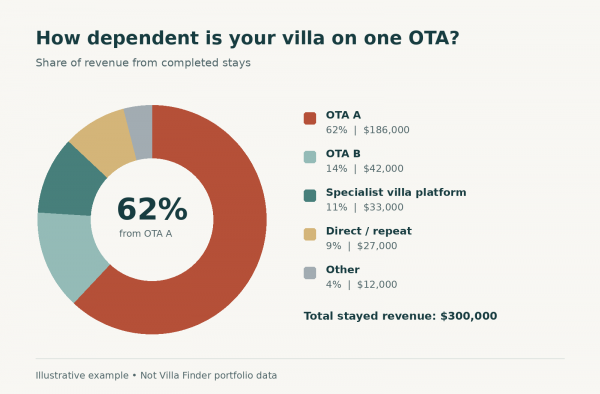
Channel concentration = revenue from your largest booking source ÷ total stayed revenue × 100
For example, if one OTA generates $186,000 of a villa’s $300,000 annual stayed revenue, its share is 62%. Listing on four other platforms does not change that exposure. This is an illustrative calculation, not Villa Finder portfolio data.
There is no universal safe percentage. A newly opened villa may need marketplace exposure more than an established property with repeat guests. What matters is whether your other booking sources could realistically help if the largest one slowed down.
Check Seasonal Exposure and the True Source of Bookings
An annual average can hide a seasonal weakness. Review channel concentration for your busiest months as well as the full year. If one platform supplies most Christmas bookings, losing visibility before that period could matter more than a slowdown during quieter weeks.
Also check where reservations originate. A booking handled by a management company may still have come through the same OTA you use yourself. Where your partners can provide this information, distinguish the business processing the reservation from the source of demand. Otherwise, you could mistake several booking relationships for several independent sources of guests.
Run a 90-Day OTA Stress Test
Imagine your biggest channel generates no new reservations for 90 days. Existing bookings remain, but the usual flow of enquiries stops. Review:
- Which upcoming dates would be hardest to fill, and how much revenue would be exposed?
- Which alternative channels already generate bookings and could take more inventory?
- How quickly could your team adjust availability and marketing?
- Could previous guests find and contact the villa again, within applicable privacy rules and booking terms?
Shaun Shirazian of Lodgify recommends combining a strong direct-booking channel with a small number of OTAs. His emphasis is on being able to continue trading if one platform disappears, rather than dividing bookings evenly across every available website.
Use the stress test to identify a realistic next step. That might mean developing an existing specialist partner or improving the booking process for returning guests. Opening several inactive listings will not provide much protection.
2. Improve Insurance Claims Readiness and Villa Safety Records
Insurance coverage and the ability to document a loss are separate parts of vacation rental risk management. Even with suitable cover, your team may need evidence of the property’s condition, damaged assets and financial losses.
Our guide to short-term rental insurance gaps covers policy types, exclusions and business interruption. This section focuses on preparing the records your insurer may ask for.
Keep a Claim-Ready Folder
A Claim-Ready Folder is simply a shared, secure collection of relevant records. Ask your broker what your policy requires, then organise the information into four groups:
- Policy details: Current documents, declared activities, insurer contacts and notification procedures.
- Property evidence: Dated photographs, records of valuable assets, invoices, serial numbers and renovation details.
- Operational records: Maintenance history, safety inspections, completed repairs and incident reports.
- Financial records: Booking history, rental revenue and supporting accounts where relevant to a claim.
Update the folder after significant changes, such as replacing expensive equipment or completing renovations. Make sure an authorised local team member can access it if you are unavailable. A folder on the owner’s laptop is not much help during an urgent incident overseas.
Prepare Records of Rental Income Before a Disruption
If your policy includes income-loss cover, ask how the insurer would expect you to substantiate that loss. Do not assume a screenshot of your advertised nightly rate will be enough. Keep records of completed stays, cancellations, refunds and relevant operating costs in a form your accountant can reconcile.
Separate confirmed reservations from forecasts. A cancelled booking and a night you hoped to sell are different pieces of evidence. Your broker can explain how the policy treats them. Keeping that distinction clear also helps you assess the business impact while repairs are being arranged.

Document Safety Checks and Completed Repairs
In his contribution to this article, Justin Ford of Breezeway highlights the need to routinely recheck basic safety conditions. Alarms, railings, lighting, pool barriers and fire extinguishers can deteriorate or fail between stays.
An inspection record should show what was checked, who checked it, any defect found and when corrective work was verified. “Pool gate checked” leaves questions unanswered. “Latch faulty on 15 September; replaced on 16 September; closure tested by the manager” gives your team something useful to work with.
3. Monitor Short-Term Rental Regulations in Your Market
Short-term rental regulations depend on the property’s location and legal operating category. Start by confirming which route applies to your villa, then track its continuing obligations. A licence or registration is only useful if the business still meets its conditions.
Bali Villa Regulations and Foreign-Guest Reporting
In its February 2026 statement about Airbnb and unlicensed tourism businesses, the Bali Provincial Government described the governor’s call for Airbnb to remove businesses that lacked licences or did not pay taxes. This was a government request, rather than proof that every affected listing had been removed. For owners, it shows how compliance concerns could also affect distribution.
There are recurring duties to check too. Indonesia Immigration’s APOA foreign-guest reporting system states that accommodation owners or managers must report international guests, and its registration categories include villas. Confirm who handles reporting at your property and where the records are kept.
Thailand Villa Licensing: Phuket and Koh Samui
Thailand has both hotel licensing and a notification route for qualifying non-hotel accommodation. The Department of Provincial Administration’s 2023 non-hotel accommodation guidance covers accommodation with no more than eight rooms and capacity for no more than 30 guests, subject to other conditions, including supplementary-income requirements.
Being below those limits does not automatically make a commercial villa exempt from hotel licensing. Ask a qualified local adviser to confirm the applicable category, notification or licensing status, building requirements and guest-reporting duties for your operating model.
Japan Short-Term Rentals and the 180-Day Rule
The Japan Tourism Agency’s Private Lodging Business Act guidance sets a maximum of 180 operating days per year under that route. Local ordinances may impose further restrictions.
The limit does not apply automatically to all tourist accommodation. Other routes include the Inns and Hotels Act and National Strategic Special Zone arrangements. For a property in Niseko, Hakuba or Furano, establish its legal route before making assumptions about how many nights you can sell.
Sri Lanka Villa and Rented-Home Registration
The Sri Lanka Tourism Development Authority’s Home Stay, Bungalow and Rented Accommodation guidelines include registration, inspections and continuing standards for accommodation operating under that scheme. These cover property condition, hygiene, facilities and guest safety.
Confirm the category that fits your property and its renewal requirements. Continuing to meet the standards matters just as much as obtaining the initial approval.
Keep a Regulatory Risk Register
Record each applicable obligation in one shared register: the person responsible, evidence of compliance, the next deadline and the consequence of missing it. Include licences, business registrations, taxes, guest reporting and required safety approvals as applicable.
Keep this separate from a general task list. A renewal deadline should remain visible even when the villa team is busy with back-to-back arrivals.
Allow time for the work preceding a deadline, too. Record when an application must be started, whether an inspection is needed and who follows up if approval is delayed. A reminder on the expiry date leaves little room to resolve missing documents.
Recheck Compliance When Your Operating Model Changes
Ask your adviser whether a planned change affects your existing permissions before committing to it. Opening additional bedrooms, increasing capacity or accepting events may require different checks from those completed when the villa first opened. The answer will depend on your jurisdiction and approvals.
Keep a written record of the advice and any resulting action. This is particularly useful when ownership, management or accounting responsibilities change: the incoming team needs to understand the basis on which the property operates.

4. Manage Guest Damage, Security Deposits and Incident Response
Guest damage management starts before check-in. Guests should understand occupancy limits, visitor and event rules, smoking restrictions, quiet hours and how damage charges are assessed. Staff also need a clear process for responding when those conditions are breached.
Clarify the Booking Before Calling It a Guest-Risk Problem
A booking request for a celebration deserves a conversation about what is planned. Ask about guest numbers, visitors, suppliers and whether the event fits the villa’s permitted use. Resolve discrepancies between the enquiry and the booking details before accepting arrangements your property cannot accommodate.
Apply those checks consistently. Focus on the proposed use and relevant booking information, rather than assumptions about a guest’s nationality, age or appearance. Clear written agreement gives both sides a reference if expectations later differ.
Set a Villa Security Deposit That Matches Its Purpose
There is no universal villa security deposit. Consider the likely damage it is intended to cover, the value of vulnerable furnishings, group size, event use and any insurance deductible. Then check what your booking terms, platform rules and local law allow.
Explain the amount, collection method, potential deductions and return process before the booking is confirmed. A deposit can provide a route to recovery, but it does not establish who caused the damage or guarantee that every loss will be reimbursed.
Use a Four-Level Guest Incident Framework
A broken glass and an unauthorised party need different responses. This practical framework helps staff judge urgency; it is not a legal classification.
| Level | Example | Response |
| 1. Minor guest issue | Lost key or small accidental breakage | Resolve promptly and record where appropriate. |
| 2. House-rule violation | Undeclared visitors or repeated noise | Document the breach and follow the agreed warning procedure. |
| 3. Material property risk | Significant damage or an unauthorised event | Escalate to the manager and preserve relevant evidence. |
| 4. Safety or security incident | Fire, serious injury or an immediate threat | Protect people first and involve emergency services where necessary. |
Give staff a primary contact, a backup and clear authority for urgent decisions. They should not have to wait for an overseas owner to wake up before addressing a safety threat.
Respond to the Four Clocks After Villa Damage
After a significant incident, several deadlines compete for attention:
- Evidence: Once it is safe, photograph the damage before cleaning or repairs alter the scene. Preserve relevant messages and earlier condition records.
- Booking platform: Check the reservation’s reporting process and submission deadlines immediately.
- Insurance: Follow the policy’s notification requirements without waiting for every repair quotation.
- Next arrival: Assess whether the villa is safe and usable, what repairs are possible and whether incoming guests need information or alternative arrangements.
For example, imagine cleaners discover a damaged sliding door shortly before another family arrives. One team member can photograph its condition and preserve the checkout messages while the manager calls a contractor. Another can check reporting deadlines and advise the incoming guests if access or safety will be affected.
Agree in advance who can authorise urgent spending, guest updates or alternative accommodation. Those decisions should follow the severity of the incident and applicable booking terms, with an escalation route when the cost exceeds the manager’s authority.
Do not delay emergency action to collect evidence. For everything else, coordinate documentation and repairs so preparing for the next guest does not erase the information needed to resolve the previous stay.

5. Turn Your Villa Risk Assessment Into an Action Plan
A useful villa risk assessment ends with decisions. Review the four areas above with your manager and mark each as documented, incomplete or unknown. Prioritise gaps that could threaten safety, interrupt legal operation or expose a substantial amount of income.
To decide where to begin, consider both likelihood and consequence. A frequent minor breakage may need a straightforward operational fix. A less frequent problem that could close the villa deserves a more deliberate response. Include the time and cost of recovery, not just the immediate repair bill.
Use this villa owner checklist to close the review:
- Identify your largest booking dependency and one practical way to reduce it.
- Confirm that your claims records are current and accessible.
- Check upcoming compliance deadlines and unresolved requirements.
- Test whether staff know how to escalate a serious guest incident.
For each unresolved issue, assign a named person and a completion date. If something needs outside expertise, specify who will contact the broker, accountant or local adviser. A quarterly review is a practical starting point, with additional checks after major operational changes or incidents.
Test one response with your team rather than relying only on a written procedure. Choose a scenario, such as damage discovered before check-in, and walk through the calls, records and decisions involved. If people give different answers, clarify the procedure while you have time to discuss it calmly.
The value of short-term rental risk management is that fewer decisions have to be improvised under pressure. When a problem occurs, your team should already know who can act, which records are needed and how to protect the next guest’s stay.
Before your next busy season, review this playbook with the people who run your villa. Start with the most consequential unanswered question and agree what will be done about it.
This article provides general educational information. Legal requirements, insurance coverage and claims procedures vary by property and jurisdiction. Confirm your individual obligations with the relevant authority and qualified local professionals.